Electric fence wiring diagram
Connect energiser, earth, fence and gate correctly, with all distances.
Download PDFFrom planning to troubleshooting: everything you need for a safe, reliable electric fence. With calculators, a wiring diagram to download and a glossary of all the key terms.
This is what a fence pulse looks like: about once per second, lasting only a fraction of a second.
Height, number of wires and required voltage at a glance.
Fence by animal →Posts, wire, insulators and the right energiser strength.
Calculators →Find the cause in just a few clicks.
Troubleshooting →Connect energiser, earth, fence and gate correctly. As a PDF.
Downloads →An energiser sends a short pulse into the fence about once per second. When an animal touches the wire, the current flows through the animal into the ground and back to the energiser via the earth rods. The circuit is closed and the animal gets a noticeable but harmless shock.
That leads to the most important point for your fence: it only works as well as its earthing. If the ground is dry or the energiser has too few earth rods, the current can't get back and the shock is weak, even with a powerful energiser.
These are guideline values for animals that are used to electric fencing. Young, inexperienced or particularly lively animals usually need one more wire. Always measure the voltage at the end of the fence, the point furthest from the energiser.
Wire heights from ground: approx. 50 and 90 cm, add 30 cm for calves
Wire heights from ground: approx. 60, 90 and 120 cm
Wire heights from ground: approx. 40, 70 and 100 cm
Wire heights from ground: netting, or wires from approx. 20 cm up to 90 cm
Wire heights from ground: netting, or wires from approx. 20 cm up to 110 cm
Wire heights from ground: approx. 20 and 45 cm, add 10 cm for piglets
With outdoor and free-range pigs, the electric fence is only the inner fence. Because of African swine fever, many countries also require a solid outer fence, in Germany and Austria at least 1.50 m high. Check with your veterinary authority.
Wire heights from ground: electrifiable poultry netting
Wire heights from ground: approx. 20, 40 and 60 cm
Wire heights from ground: approx. 20, 40, 60, 90 and 120 cm
For protecting livestock against wolves, your country often has its own requirements, especially if you apply for funding. Ask your local authority for the minimum heights and number of wires.
Enter the size of your paddock to see roughly how much material you need and how powerful your energiser should be. The figures are guideline values for planning.
With this much conductor, rope or tape with low resistance is worth it, so that enough voltage reaches the end of the fence.
You'll find the consumption in milliamps in your energiser's technical data. The calculation uses 80 % of the battery capacity, as a battery should never be run completely flat. Cold weather shortens the runtime.
Walk the line and mark corners, gates and narrow spots. Keep away from roads, power lines and trees whose branches could later fall onto the fence.
They carry the full tension of the fence. Set them deep and firm, and brace them with a strut on permanent fences.
Plastic posts about every 4 to 6 m on temporary fences, wooden posts about every 8 to 10 m on permanent fences. On wooden posts the insulator keeps the conductor away from the post.
Thread the conductor through the insulators and tighten it with a fence strainer. Join pieces with proper connectors rather than knots, as a knot conducts poorly and breaks easily.
Use gate handles at the gate. To keep current flowing when the gate is open, run an underground cable in a conduit beneath the gateway.
Drive at least three earth rods 3 m apart into a damp spot and connect them. See the earthing section above for details.
Connect the earth terminal first, then the fence terminal, and switch on the energiser. Measure the voltage at the end of the fence and put up warning signs. Let the animals get used to the fence in a small paddock.
Select what you're seeing. For troubleshooting you need a fence tester to measure the voltage at different points.
The most common questions about safety, gardens and neighbours. Legal requirements vary by country and municipality, so if in doubt, ask locally.
Not for healthy people and animals. A certified energiser emits a very short pulse about once per second, and the energy is strictly limited. The shock is unpleasant but harmless. It only becomes life-threatening if someone connects a fence directly to mains power without an energiser. That is prohibited.
Usually yes, as long as you use a certified energiser and the fence is clearly visible to others. Your local authority can tell you whether there are additional rules for your residential area.
This is governed by neighbour law, which differs from country to country and often from region to region. It's best to ask your local authority. In any case, position the fence so that neighbours and passers-by can't touch it by accident.
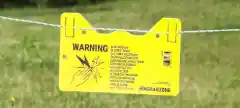
Yes, as soon as the fence runs along public paths or roads. Then a warning sign belongs on the fence about every 100 m, plus one at every gate and crossing point.
Not for a healthy dog. It gets a fright and avoids the fence afterwards. With puppies and small dogs, make sure they can't get caught in netting. An animal that is stuck would otherwise keep receiving pulses.
Very little. Mains energisers usually need only a few watts, which hardly shows on your electricity bill. With battery energisers, the consumption in milliamps decides how long a charge lasts. Work it out with the battery calculator above.
No. One fence takes exactly one energiser. Two energisers on one conductor interfere with each other and together exceed the permitted pulse energy.
Use the search or the letters to find even more terms.
We don't have an explanation for that here yet. Just ask our customer service, we're happy to help.
+43 7746 28582 · [email protected]
To print and take out to the paddock.
Connect energiser, earth, fence and gate correctly, with all distances.
Download PDFOur customer service team is happy to help.